
- Analyse the current Strengths, Weaknesses, Opportunities and Threats of a company and explain the internal/external distinction between them.
- Explain why the same factor can be a strength for one organisation and a weakness for another.
- Describe what data is required for a SWOT analysis and how a basic vs. a more sophisticated SWOT differs.
- Interpret a SWOT analysis.
1. Introduction & objectives
SWOT stands for Strengths, Weaknesses, Opportunities, and Threats. An analysis of these elements gives an organisation an overview of its position in relation to its external and internal environments. Strengths and weaknesses arise from the internal environment, resources and how they are used, organisational structure, culture and business functions. Opportunities and threats stem from the external environment. Deciding which strengths to build on and which weaknesses to minimise is guided by the impact of external opportunities and threats.
2. The parts of the tool
Strengths
A competence, valuable resource, or positive attribute an organisation uses to exploit opportunities or counter threats: a well-motivated, low-turnover workforce or a strong brand, for example. Strengths (like weaknesses) are intrinsic to an organisation, so the same feature can be a strength for one company and a weakness for another. A loyal customer base is a strength in a stable market, but it can turn into a weakness if those customers resist trying new products.
Weaknesses
The absence of a competence, resource or attribute an organisation needs to exploit opportunities, counter threats, or outperform competitors — for example a lack of skilled employees, insufficient knowledge of customer preferences, financial resource deficits or obsolete machinery. Some factors, such as a lack of funds, are weaknesses in any organisation; others depend on context (e.g. an experienced but change-resistant workforce).
Opportunities
Prospects in the external environment that an organisation could exploit to gain an advantage. The rise of mobile telephony, for example, created opportunities well beyond phone manufacturers, including education providers delivering learning materials via platforms such as OpenLearn, Coursera and edX. In the drone industry, firms such as DJI have capitalised on technological advances to dominate the market for aerial photography and videography.
Threats
Factors with the potential to adversely affect an organisation’s performance, often originating from competitors or from factors beyond its control, such as legislative or tax changes, technological shifts an organisation struggles to adopt, resource shortages, or adverse weather events. In the drone sector, regulatory changes imposing stricter controls on drone usage could threaten firms’ ability to expand their market reach.
Data required
Externally: data on market trends, competitor analysis, regulatory changes, technological advancements and broader economic, political, social and environmental conditions, to identify potential opportunities and threats.
Internally: information on resources, capabilities and current performance such as financial statements, workforce skills, inventory levels, production capabilities, operational efficiency, customer feedback, sales data and market share.
Application method
A basic SWOT analysis examines how threats and opportunities can be addressed while leveraging strengths and managing weaknesses, using concise, specific lists, and considering both the organisation’s current situation and its aspirations for the future.
A more sophisticated approach considers strengths, weaknesses, opportunities and threats in relation to key business functions, marketing, operations, human resources, accounting, finance and, occasionally, information management. For instance, a drone company like DJI might identify strengths in advanced engineering, weaknesses in regulatory compliance, opportunities in new geographical markets, and threats from competitors and regulatory change.
3. Example of application
The example below shows a SWOT analysis for a hypothetical company, VineFly, which provides vineyard disease detection in Southern Europe:
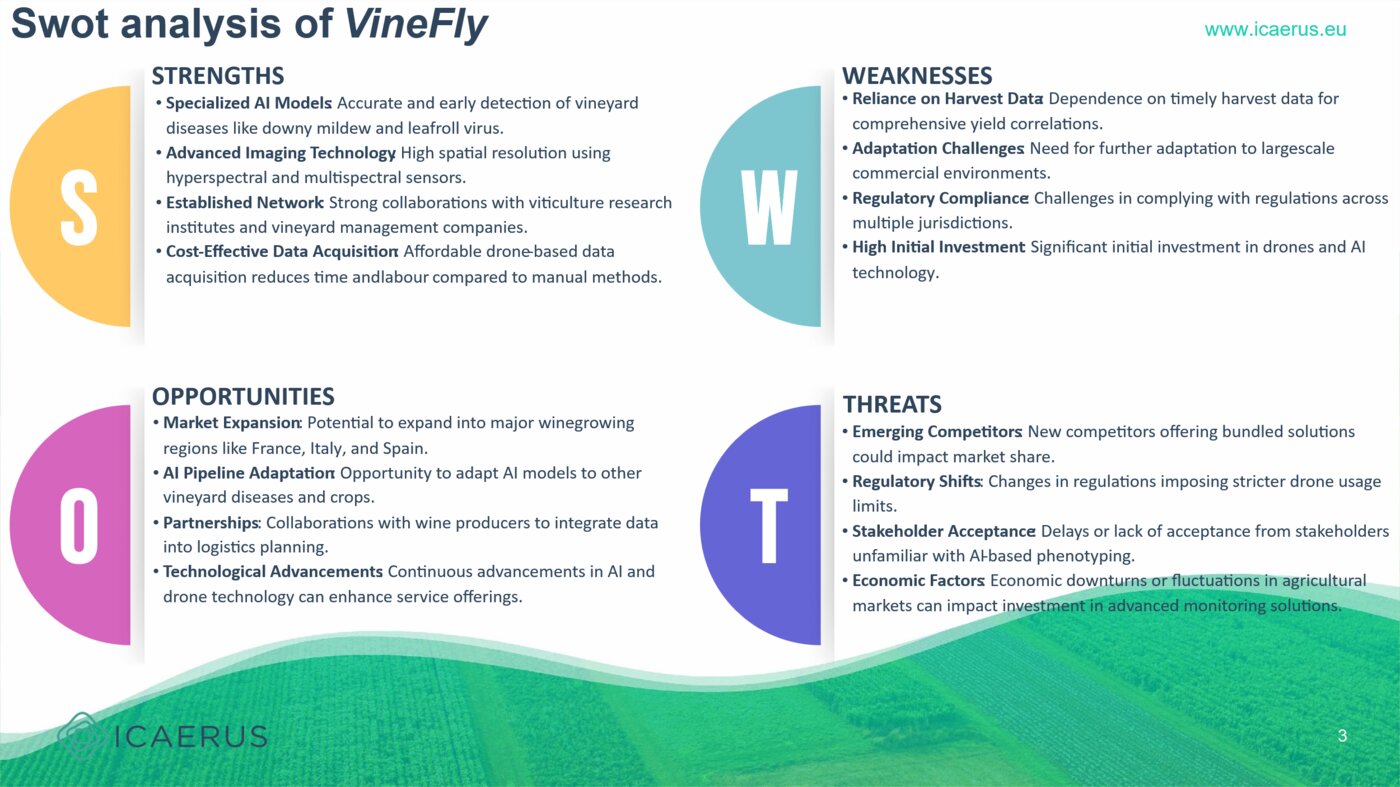
VineFly lists ‘High Initial Investment’ as a weakness and ‘Market Expansion’ as an opportunity. What strategic action could VineFly take to use its strengths to turn this weakness into an advantage while pursuing the opportunity?