
- Explain how the Triple Layered Business Model Canvas (TLBMC) extends the classic Business Model Canvas.
- Describe the nine building blocks of each of the three layers: economic, environmental and social.
- Distinguish between the horizontal and vertical coherence of the TLBMC.
- Apply the TLBMC to a real example: a ‘Drone as a Service’ (DaaS) business model.
1. Introduction & objectives
The Triple Layered Business Model Canvas (TLBMC) is a Business Model Tool for depicting sustainable business models. What makes it different is the addition of two further layers on top of the economic one: an environmental layer and a social layer. Patterns of interaction show up within each layer and across them, which together make the TLBMC much better at showing how a business model creates value along three dimensions: economic, social and environmental. The TLBMC was introduced by Joyce and Paquin (2016) to create a business model tool that, when represented visually, immediately conveys an all-rounded, holistic interpretation of a business model.
The purpose of the tool, within the ICAERUS Value-Added Services, is to transfer structured knowledge and applied business-modelling practice from the ICAERUS Use Cases to Open Call Trial Beneficiaries. The TLBMC was chosen because it captures not only the economic aspects of a business model but also its environmental and social dimensions, in line with ICAERUS’s vision of promoting sustainable, inclusive and scalable UAV-based services. It performs a dual function: knowledge codification (capturing and documenting the rationale and structure of Use Case business models) and knowledge transfer (acting as a capacity-building and mentoring tool during workshops, to guide and inspire Open Call participants developing their own business models).
2. The parts of the tool: the three layers
2.1 · The economic layer
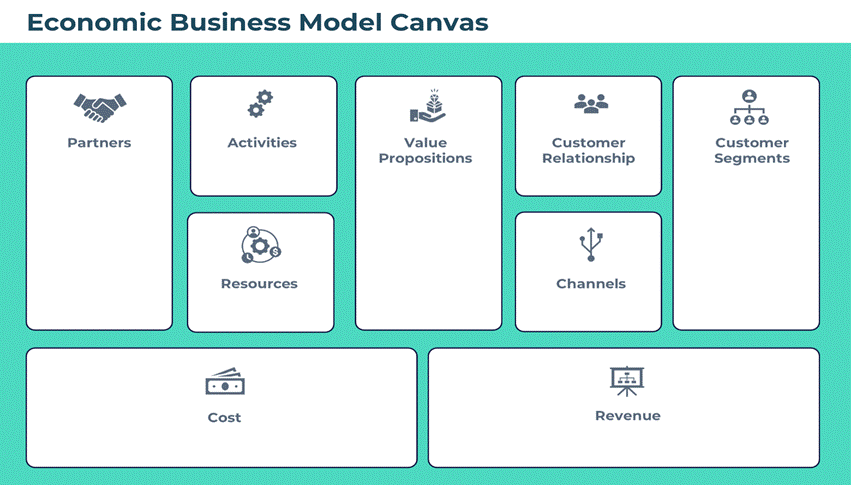
The TLBMC builds on the original Business Model Canvas (Osterwalder et al., 2010), whose nine interconnected components are described below. Osterwalder and Pigneur insisted the Canvas should always be a one-page document with a single, robust message, using graphical icons to keep it succinct.
| Economic block | Description |
|---|---|
| Key activities | The most important activities in executing the value proposition. |
| Key resources | The human, financial, physical and intellectual assets needed to create value for the customer. |
| Key partners / networks | Buyer-supplier relationships cultivated to optimise operations and reduce risk. |
| Value propositions | The services offered to meet customer needs — through newness, performance, customisation, design, price, cost or risk reduction, accessibility, convenience, etc. |
| Customer segments | The customers the business tries to serve. |
| Channels | The routes through which the value proposition reaches customers — fast, efficient and cost-effective. |
| Customer relationships | How the business will acquire customers and keep them purchasing or using its services. |
| Cost structure | The most important monetary consequences of operating the business model — cost-driven or value-driven. |
| Revenue streams | How the business is expected to generate income from each customer segment. |
If you are interested in learning more about this fundamental level, go to Developing business ideas for drone technologies: Week 5: Introduction | OpenLearn – Open University and Week 6: Introduction | OpenLearn – Open University. These two 4-hour sessions explain how to develop a solid business model canvas.
2.2 · The environmental layer
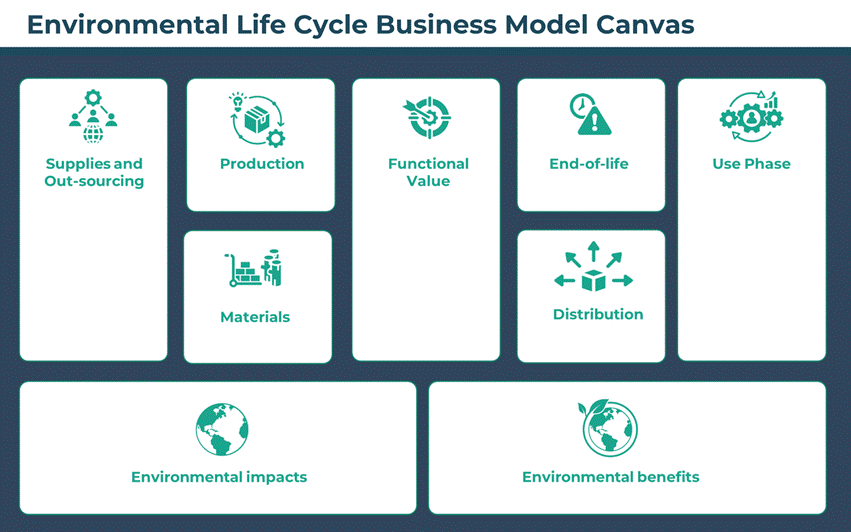
The environmental layer uses a life-cycle approach based on Life Cycle Assessment (LCA) to measure a service’s overall environmental impact, mirroring the logic of the economic layer: just as the BMC shows how earnings outweigh costs, the environmental layer shows how the business model can generate more environmental benefits than impacts.
| Environmental block | Description |
|---|---|
| Functional value | Models the service’s functional unit in LCA terms. |
| Materials | The environmental counterpart of Key Resources — the key materials with the greatest environmental impact. |
| Production | The environmental counterpart of Key Activities — the production activities with the greatest environmental footprint. |
| Supplies & outsourcing | The environmental counterpart of Partners — production/material activities not integral to delivering the value proposition. |
| Distribution | The environmental counterpart of Channels — e.g. logistics involved in assembling and delivering drones. |
| Use phase | The environmental impact of the functional value in use, including maintenance. |
| End-of-life | Repurposing or reuse of materials/production elements, e.g. drone batteries or add-ons. |
| Environmental impacts | The ecological costs of the business model, e.g. CO₂ emissions or resource depletion. |
| Environmental benefits | The environmental counterpart of Revenue — opportunities to reduce negative or increase positive environmental impact. |
2.3 · The social layer
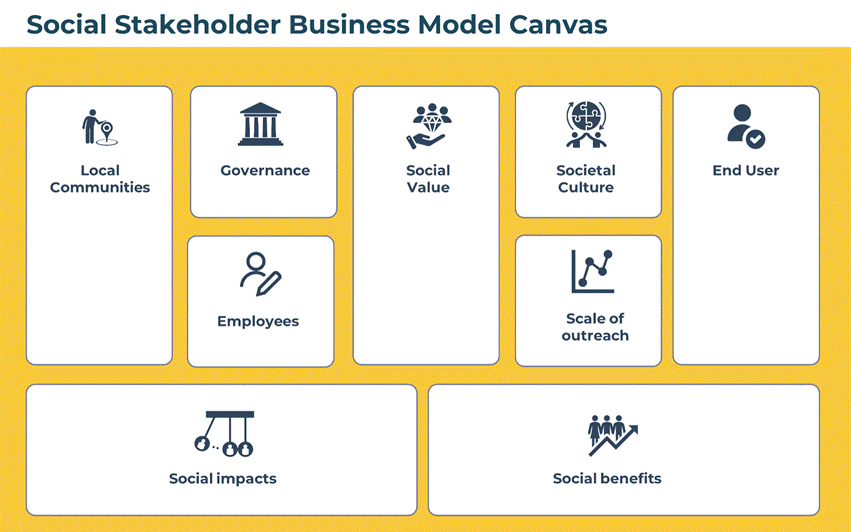
The social layer presents a dedicated view of how the business model’s elements interact with all the stakeholders of the value proposition, and acts as a thorough tool to develop and design governance models.
| Social block | Description |
|---|---|
| Social value | How the business model’s mission creates benefit for stakeholders and society in general. |
| Employees | Employees as organisational stakeholders of the business model. |
| Governance | The organisational structure and decision-making policy. |
| Communities | The social counterpart of Partners — relationships between suppliers and the local communities they involve. |
| Societal culture | The overall potential impact of the organisation on society. |
| Scale of outreach | The strength of the relationships built with stakeholders. |
| End-users | The social counterpart of Customer Segments — how the value proposition meets end-users’ needs. |
| Social impacts | The social cost of the business model, alongside its economic and environmental counterparts. |
| Social benefits | The positive social aspects of the value-creation process. |
2.4 · Vertical and horizontal coherence
What sets the TLBMC apart is this holistic view of a business model, which weighs environmental and social concerns alongside the economic ones.
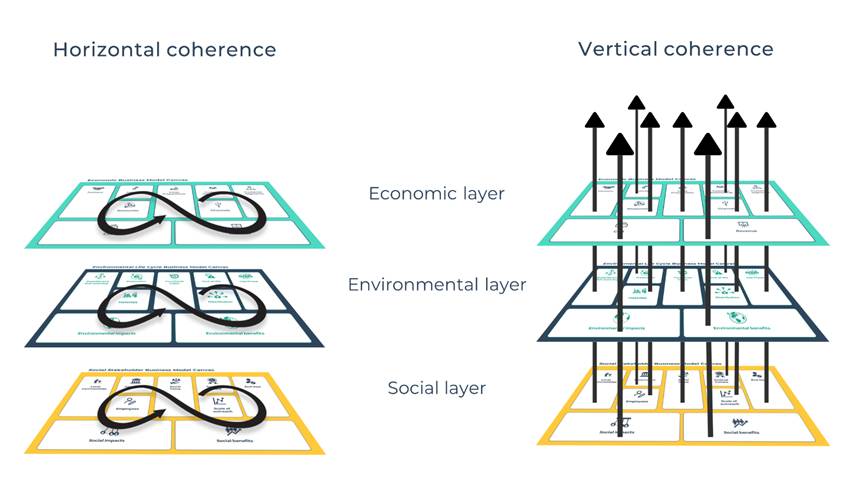
- Horizontal coherence: the in-depth examination of a sustainable business model within a single layer, presenting succinctly the different types of value creation it generates.
- Vertical coherence: achieved by aligning each layer of the TLBMC, so that interaction patterns can be examined across economic, environmental and social value. This produces a much higher-resolution picture than other tools, since relationships can be traced from one element to another.
3. Example of application: a “Drone as a Service” business model
Across the ICAERUS Use Cases, one pattern kept coming up: teams moved away from selling drones as products and towards a “Drone as a Service” (DaaS) approach instead, packaging services such as spraying, monitoring or data analysis so users could access them on demand, without needing to own or operate the technology themselves. The TLBMC proved especially useful here, helping teams work through what this model would actually mean in practice.
| Layer | Element | Example inputs (Drone as a Service) |
|---|---|---|
| Economic | Key Partners | Drone manufacturers, software providers |
| Key Activities | Flight planning, spraying services | |
| Key Resources | UAV fleet, cloud processing platform | |
| Value Proposition | Affordable access to precision services, pay-per-use flexibility | |
| Customer Segments | Farmers, agri-cooperatives | |
| Channels | Digital platform, agricultural advisors | |
| Customer Relationships | Training, ongoing support | |
| Revenue Streams | Service fees, subscription models | |
| Cost Structure | Equipment leasing, staff costs | |
| Environmental | Supplies & Outsourcing | Eco-certified component suppliers, open-source software |
| Production | Modular assembly, lifecycle tracking | |
| Materials | Recyclable plastics, rechargeable batteries | |
| Functional Value | Reduced emissions, less agrochemical use | |
| Distribution | Local delivery hubs, drone operators | |
| Use Phase | Battery recharge cycles, low-noise operation | |
| End-of-Life | Component recycling, refurbishing | |
| Environmental Impacts | Reduced CO₂, less soil compaction | |
| Environmental Benefits | Improved biodiversity, waste minimisation | |
| Social | Local Communities | Rural farmer networks, NGOs |
| Governance | Fair-use policy, data governance | |
| Employees | Drone pilots, local tech teams | |
| Social Value | Safer spraying, labour replacement | |
| Societal Culture | Tech-adoption culture, gender inclusion | |
| Scale of Outreach | Regional workshops, field demos | |
| End-users | Agricultural SMEs, organic producers | |
| Social Impacts | New job roles, reduced exposure | |
| Social Benefits | Digital inclusion, better health outcomes |
Table 4.8 · Example of a TLBMC for a “Drone as a Service” model
In the economic layer, the DaaS approach was built around service efficiency, cost savings and access to advanced technology. Key partners often included AI software providers, drone manufacturers and regulatory bodies ensuring compliance, with revenue shaped by subscription fees, pay-per-use contracts, or public-private partnerships.
The environmental layer raised questions that a traditional model might overlook: teams examined ethically sourced materials, recyclable components and low-emission drone operations, with the Use Phase and End-of-Life tiles prompting reflection on resource intensity and reuse potential.
The social layer opened opportunities for skills development, rural job creation and community-level adoption, with ethical considerations such as data privacy and informed consent for aerial monitoring discussed as integral parts of the model, alongside clear governance and decision-making structures.
Working through all three layers together helped teams build models that were ambitious but still grounded: economically viable, environmentally responsible and socially embedded. This DaaS model is now a reference point for other Open Call Trial beneficiaries exploring similar service-based ideas.
Choose one economic-layer element from the DaaS example (e.g. Revenue Streams) and trace its vertical coherence: which environmental- and social-layer elements does it most directly connect to, and why?
If you want to experiment more with the TLBMC, go to the ICAERUS Business Model Wizard, which will guide you through developing a business model canvas based on the ICAERUS use cases.
References
Joyce, A., & Paquin, R. L. (2016). The triple layered business model canvas: A tool to design more sustainable business models. Journal of Cleaner Production, 135, 1474–1486. https://doi.org/10.1016/j.jclepro.2016.06.067
Osterwalder, A., Pigneur, Y., & Clark, T. (2010). Business model generation: A handbook for visionaries, game changers, and challengers. Wiley.