
- Explain what a strategy tool is and why different tools are used at different stages of the strategy process.
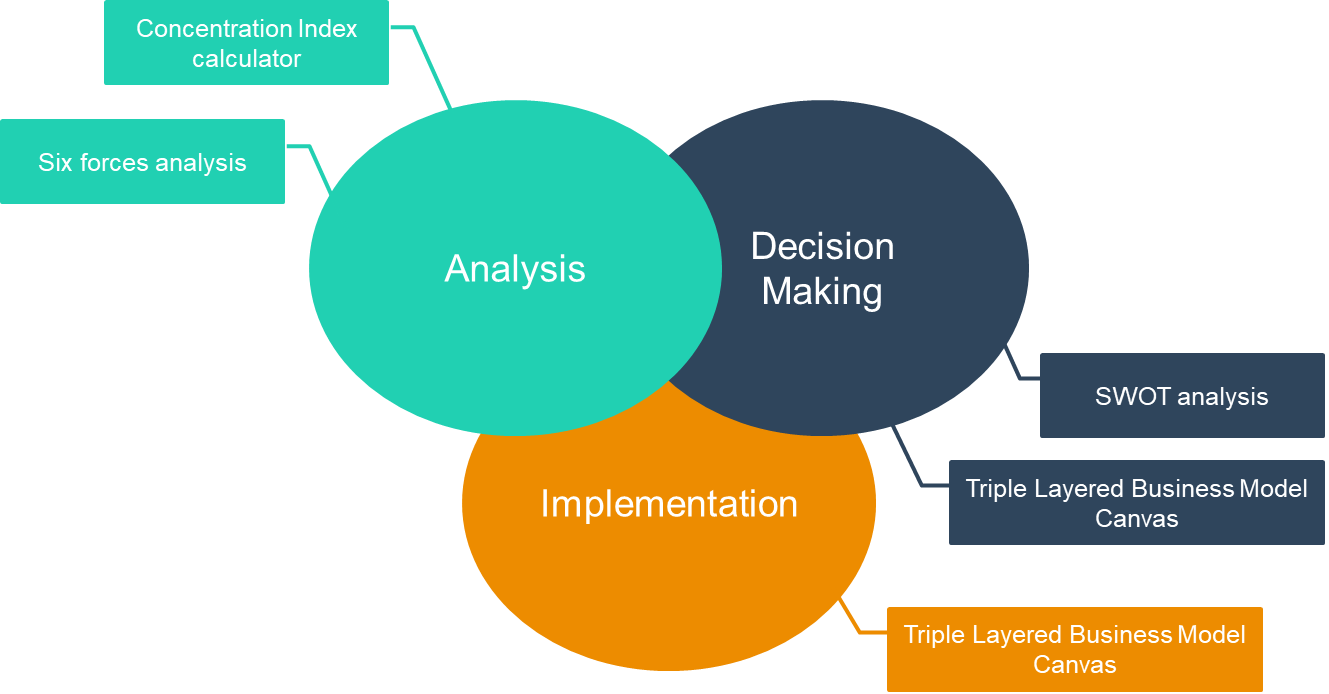
- Locate each of the four tools within the analysis, decision-making and implementation phases of strategy-making.
- Describe, in one sentence each, what each tool is used for.
Why four different tools?
According to Paroutis et al. (2015), strategy tools can be defined as “concepts, models and methods employed by managers during strategy making”. Different strategy tools tend to be used at different points in the strategy process, which is typically divided into three phases: analysis, decision making and implementation (Johnson et al., 2017; Lynch, 2015).
This course introduces four tools, each connected to a different phase of the strategy process, so that they can better serve the needs of the people using them. The calculation of the Concentration Index and the Six Forces Analysis are typical competitive-analysis tools: they help evaluate an organisation’s strategic positioning within an industry. The SWOT Analysis supports thinking about which strategies can build on an organisation’s strengths and reduce its weaknesses, in light of the threats and opportunities in its competitive environment. Finally, the Triple Layered Business Model Canvas is a design tool linked to both the decision-making and implementation phases, as it shows how to design a business model and make sure its different aspects work well together.
A study of 46 managers found that both the Six Forces Analysis and the SWOT Analysis were valued for helping to “divide areas up to provide a clear picture” (Wright et al., 2013): both tools help managers break a complex competitive picture down into parts they can actually discuss.
At a glance: the four tools
| Tool | What it is used for |
|---|---|
| 1. Concentration Index Calculator | Measures how concentrated an industry is (few dominant firms vs. many small ones), using the n-firm concentration ratio and the Herfindahl–Hirschman Index. |
| 2. Six Forces Analysis | Expands Porter’s Five Forces with a sixth force (bargaining power of complements) to assess the attractiveness and profitability of an industry. |
| 3. SWOT Analysis | Reviews an organisation’s internal Strengths and Weaknesses against external Opportunities and Threats. |
| 4. Triple Layered Business Model Canvas | Extends the classic Business Model Canvas with an environmental layer and a social layer, to design and implement sustainable business models. |
References
Johnson, G., Whittington, R., Regnér, P., Scholes, K., & Angwin, D. (2017). Exploring Strategy: Text and Cases (11th edition). Pearson.
Lynch, R. L. (2015). Strategic management (Seventh edition). Pearson.
Paroutis, S., Franco, L. A., & Papadopoulos, T. (2015). Visual Interactions with Strategy Tools: Producing Strategic Knowledge in Workshops. British Journal of Management, 26, S48–S66. https://doi.org/10.1111/1467-8551.12081
Wright, R. P., Paroutis, S. E., & Blettner, D. P. (2013). How Useful Are the Strategic Tools We Teach in Business Schools? Journal of Management Studies, 50(1), 92–125. https://doi.org/10.1111/j.1467-6486.2012.01082.x